Tennis Court Construction · Orlando, FL
Build Your Tennis Court Right.
Asphalt or Concrete?
The most important decision in your project — and the one most people get wrong. Learn the correct construction process and make an investment that lasts for decades.
Get Free Estimate
Call Now
The Most Critical Decision: Asphalt or Concrete?
Do you dream of a high-performance tennis court in Orlando, but the question of which base to choose is holding you back? This is the most critical decision of the project, directly impacting cost, durability, playing quality, and future maintenance expenses.
At Brito Oliveira Sports Courts, we don’t just build courts — we deliver a superior playing experience that lasts for decades. This transparent guide will show you the correct construction process and help you understand the pros and cons of each option, so your investment is as smart as possible.
Asphalt vs. Concrete: An Honest Comparison
Both materials can create excellent courts, but their characteristics, durability, and lifetime costs are very different.
| Feature |
Asphalt Court |
Concrete Court |
| Initial Cost |
Lower (15-25% cheaper) |
Higher initial investment |
| Base Durability |
15–20 years |
40–60+ years |
| Crack Resistance |
Vulnerable (Florida heat & humidity) |
Extremely resistant |
| Maintenance |
High — full resurface + repaint every 4-6 years |
Minimal — repaint only every 5-8 years |
| Playing Quality |
Good when new, degrades over time |
Excellent and consistent for its entire lifespan |
| Florida Climate |
Expands/contracts with heat |
Ideal for Florida’s climate |
| Property Value |
Good |
Excellent — permanent asset |
Asphalt is appealing due to its lower initial cost. However, that saving can turn into recurring expenses if construction is not done correctly.
Pros
- Lower initial cost
- Good playability when new
- Faster installation
Cons
- Cracks from Florida heat
- Recurring maintenance costs
- Shorter lifespan (15-20 yrs)
- Full resurface required for any repair
For those seeking durability, performance, and peace of mind, concrete is the definitive choice. The initial investment pays for itself many times over.
Pros
- 40–60+ year lifespan
- Virtually crack-free
- Minimal maintenance
- Increases property value
- Consistent play surface
Cons
- Higher initial cost
- Longer installation time
⚠️ The Truth About Asphalt Maintenance
There is no such thing as “repairing just one crack.” Any repair requires a complete resurfacing and repainting of the entire court. The cost to repair and repaint can reach $10,000–$15,000 every 4–6 years. Without the right construction technique, your cheaper court becomes an expensive and frustrating investment over time.
See the Difference: Wrong vs. Right
These are real courts in Florida. The difference is not just aesthetics — it’s the construction process.
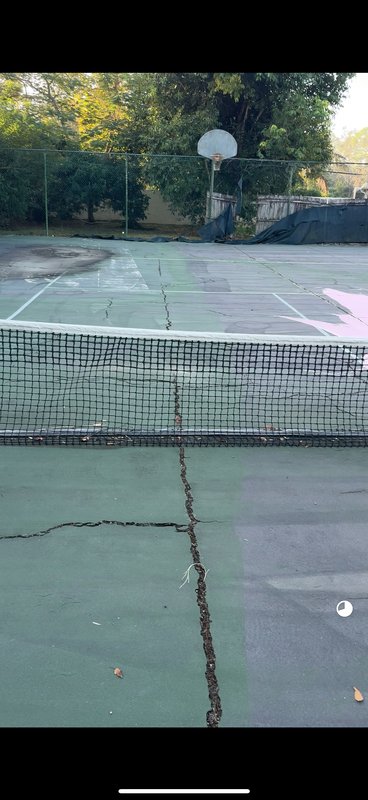
❌ Wrong Construction
Asphalt court with improper base — deep cracks after just a few years
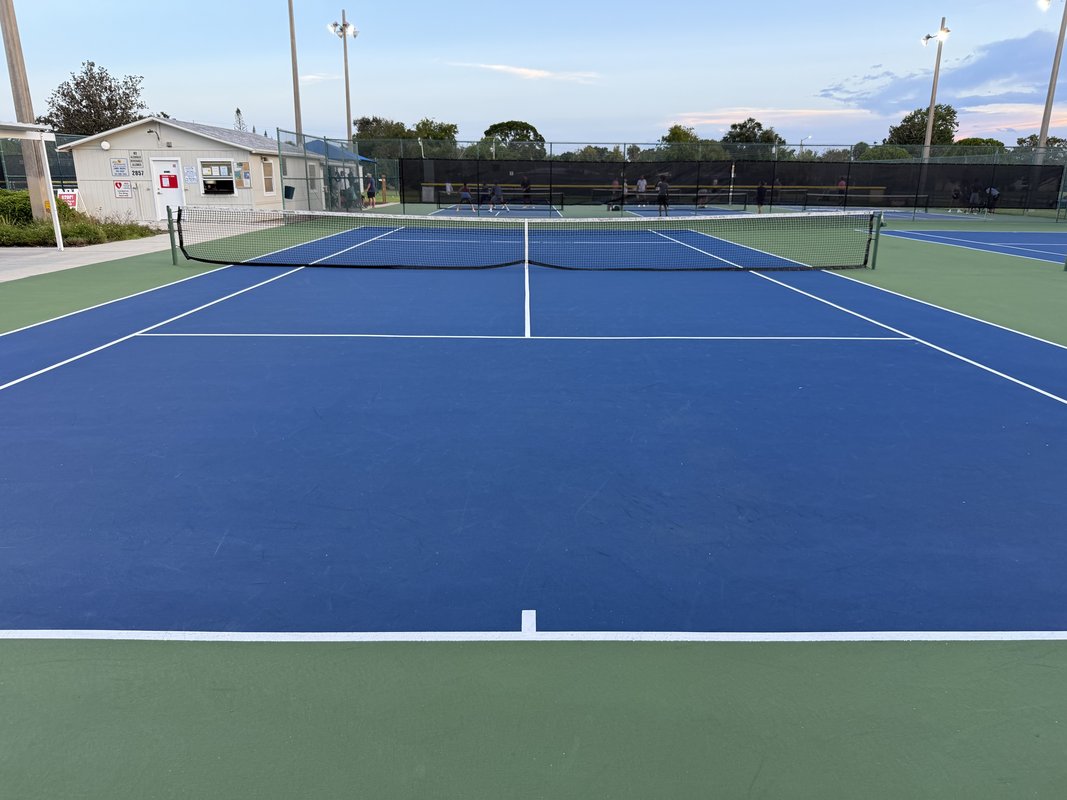
✅ Brito Oliveira Standard
Uniform acrylic surface, professional lighting, zero cracks
The Correct Construction Process: Our Secret to Durability
Many builders take shortcuts to offer a lower price, resulting in courts that crack and deteriorate in just a few years. At Brito Oliveira, we follow a rigorous process that guarantees maximum longevity.
🏗️ Asphalt Court Construction Step-by-Step
1
Site Preparation
Complete removal of all grass, roots, stumps, and underground pipes. No shortcuts — a clean base is everything.
2
Soil Leveling & Compaction
The ground is precisely leveled and mechanically compacted to prevent future settling.
3
5-Inch Paver Base Critical Step
We install a minimum 5 inches of compacted crushed stone (paver base). This is where most cheap contractors cut corners — and where courts fail.
4
Drainage System
A proper drainage system is installed to prevent water from accumulating under the base — a major cause of cracking in Florida.
5
2-Inch Asphalt Layer
Application of 2 inches of high-quality asphalt over the compacted base.
6
30-Day Curing Period Our Differentiator
The court cures for a full 30 days — a crucial step that most builders skip. This allows the asphalt to fully stabilize before any surface is applied.
7
Fiberglass Mesh Application Anti-Crack Shield
We apply a fiberglass mesh over the entire court surface before painting. This absorbs the natural movement of the asphalt and prevents cracks from reaching the paint layer — dramatically extending the surface life.
8
Professional Finish
2 coats of resurfacer + 2 coats of acrylic paint (both with sand for texture), line painting, net posts, fencing, benches, and lighting installation.
🏗️ Concrete Court Construction Step-by-Step
1
Full Site Clearance
Removal of all vegetation, roots, stumps, and underground pipes. Complete and thorough.
2
Soil Leveling, Compaction & Drainage Slope
Precise leveling with the correct slope to ensure proper water drainage — critical in Florida’s rainy season.
3
Paver Base Installation
Compacted paver base layer with precise drainage slope built in.
4
Wooden Formwork & Vapor Barrier
Wooden forms define the court boundaries. A thick plastic vapor barrier is installed to prevent ground moisture from affecting the concrete — essential in Florida.
5
Steel Rebar + 3500 PSI Fiber Mesh Concrete Maximum Strength
Steel rebar (5×5 gauge 10) is installed where needed, and we pour 3500 PSI concrete with fiber mesh for maximum structural strength and crack resistance.
6
Semi-Broom Finish & Expansion Joints
The surface is semi-broomed for optimal paint adhesion. Expansion joints are cut every 10×10 feet to control any natural movement and prevent uncontrolled cracking.
7
Primer + 2 Coats Resurfacer + 2 Coats Acrylic Paint
Full professional surface system ensuring a perfect, durable playing surface.
8
Line Painting & Full Installation
Precise line painting, net installation, fencing, benches, and professional lighting.
40–60
Years lifespan for concrete courts
30
Days curing time for asphalt (our standard)
100+
Courts built in Central Florida
Frequently Asked Questions
How much does it cost to build a tennis court in Orlando?
The cost varies depending on the base material, size, and accessories. An asphalt court typically starts around $68,000–$85,000, while a concrete court starts at $79,000–$93,000. These prices include base preparation, surface coating, line painting, net posts, and fencing. Contact us for a free, detailed estimate for your specific project.
Can I convert my old asphalt court to concrete?
Not directly. An asphalt court that has reached the end of its life needs to be completely removed before building a new concrete base. Attempting to pour concrete over old asphalt will result in structural failures. However, if your asphalt court is in good condition, we can resurface it and apply the fiberglass mesh system to extend its life significantly.
Why does my asphalt court keep cracking even after repairs?
This is almost always a base problem. If the original court was built with an insufficient base (less than 5 inches of compacted stone) or without proper drainage, cracks will keep coming back regardless of surface repairs. In many cases, a full reconstruction is the only permanent solution.
How long does it take to build a tennis court?
For an asphalt court, the construction process takes approximately 2-3 weeks, plus the mandatory 30-day curing period before surface coating. A concrete court takes 3-4 weeks for construction, plus curing time. Total project completion is typically 6-8 weeks from start to finish.
Ready to Build Your Dream Tennis Court?
Get a free, no-obligation estimate from Central Florida’s most trusted sports court builders. We’ll analyze your project and provide a transparent, detailed quote.
Get My Free Estimate
Call (407) 255-5511